When we talk about ‘voice’, what do we mean? It might seem simple on the surface, but there are quite a few components we need to consider. This section touches on how we produce our voice, and the aspects of voice which relate to how other people perceive gender when hearing someone’s voice.
The Source-Filter Model
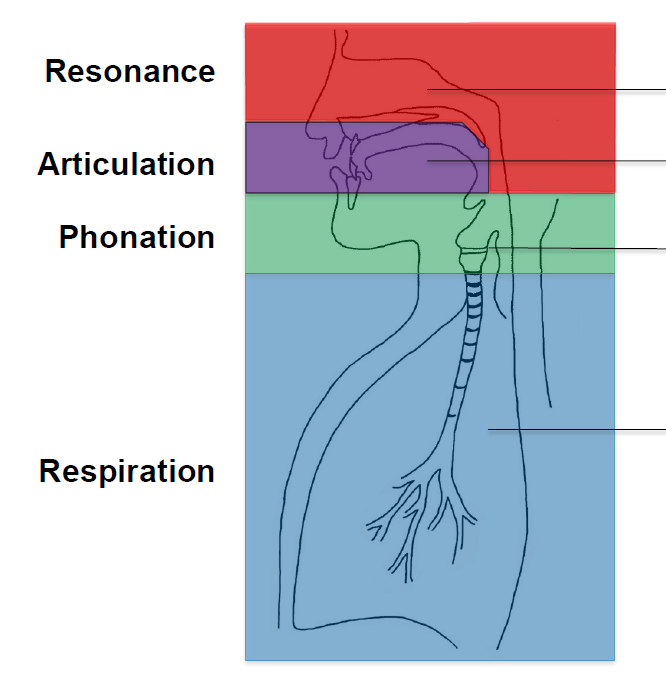
First, to speak effectively, our lungs need to produce enough force to push air up and out of the mouth. If we don’t have or use enough force, then our voice can sound weak, quiet or we can run out of air before we finish our sentence. This makes up the concept of ‘Power’ (it’s not in the name of the model but is still very important!)
Our vocal folds make up the ‘Source’ component of this model. The vocal folds can close or open to stop or allow air to travel from the lungs up into the mouth and nose. When air passes through the vocal folds, they vibrate and create sound. The different ways in which the vocal folds come together in this manner can give rise to different vocal qualities, for example, a breathy vocal quality or a rough vocal quality.
For more information about the structure of the vocal folds and larynx, see Vocal fold function.
Once the air reaches our mouth and nose, it then needs to be shaped by our tongue, lips and teeth, which make up the ‘Filter’. By moving the placement of these different parts, you can change the sound you are making. For example, try making an ‘ee’ sound (like in “tree”), then round your lips as if you were drinking through a straw. Now the sound you’re making sounds closer to ‘oo’ (like in “too”).
All these different parts of the body interact to create the unique sound of someone’s voice, and by changing the way they function, we can alter the sound of our voice.
Footnotes
[1] Fant, G. (1981). The source filter concept in voice production. Speech Transmission Laboratory Quarterly Progress and Status Report, 22, 21–37.