The vocal folds (VFs), also known as “vocal cords,” are composed of two bands of muscle and soft tissue inside the larynx, commonly known as the “voice box.” You can picture the VFs as there being a right and left VF inside the larynx. The VFs are responsible for creating the sound that becomes your voice.
Vocal Fold Composition
Each VF is composed of a thyroarytenoid muscle, more specifically the vocalis part of this muscle. Layered on top of this muscle is soft tissue, known as mucous membranes. The movement of these flexible, mucous membranes is responsible for voice production.
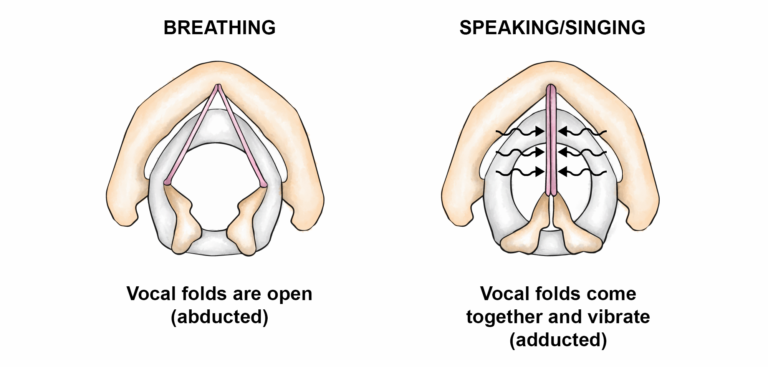
How Voice is produced
- You breathe out from your lungs, pushing air out
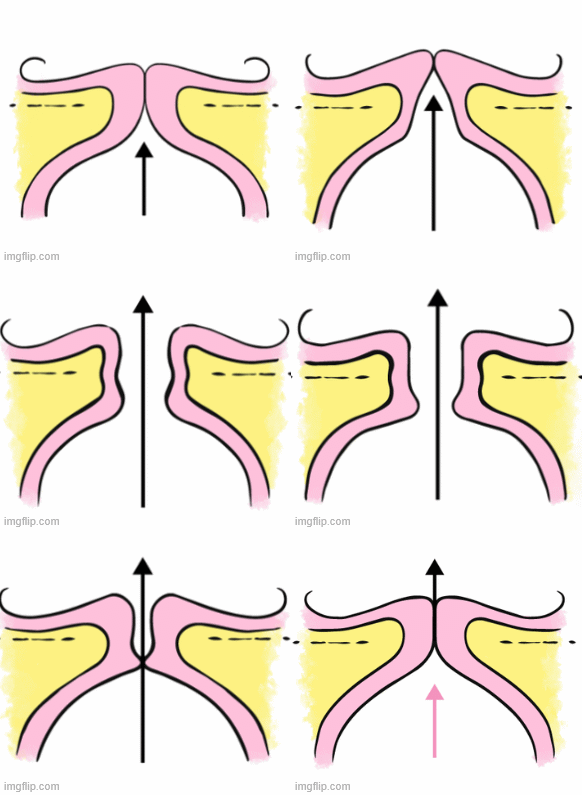
- The VFs move closer together (adduct), leaving only a very small gap between them
- The VFs are moved closer together by the action of multiple muscles – the lateral cricoarytenoid and the inter-arytenoids
- Air pressure builds beneath the folds, from the action of you breathing out
- This building air pressure forces the VFs open briefly, allowing air to flow through the VFs
- This airflow causes the VFs, specifically the mucous membranes, to vibrate rapidly, producing sound
- The air pressure creates a suction effect, closing the VFs again
Sound travelling up through the VFs is then shaped into speech by the throat, mouth, tongue, and lips.
What Affects the sound of your voice?
| VF Feature | Voice Effect | Relevance to Gender-Affirming Voice Care |
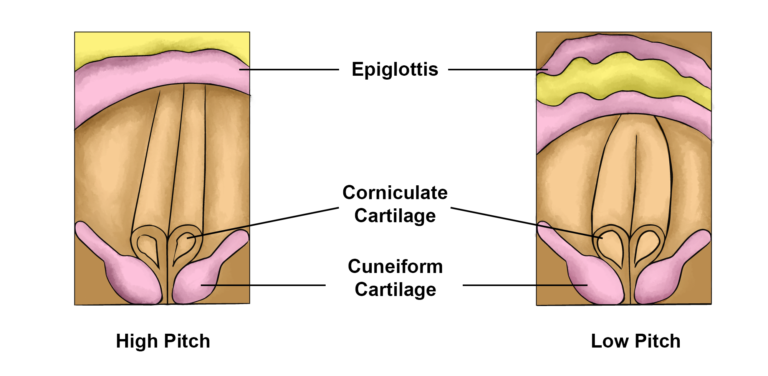
| Thickness / Mass | Thicker folds vibrate more slowly, creating a lower pitch [5] | Testosterone causes VF bulk and mass to increase. [6] Oestrogen slightly increases VF bulk and mass to a lesser extent during puberty [3], however does not have a significant effect with gender-affirming hormone therapy post-puberty [1]. |
| Length | Longer folds vibrate more slowly, creating a lower pitch [4] | Testosterone causes VF length to increase [6]. Oestrogen slightly increases VF length to a lesser extent during puberty [3], however does not have a significant effect with gender-affirming hormone therapy post-puberty [1]. |
| Stretch / Tension | Increased tension and pull on the VFs, will make the VFs thinner. This allows them to vibrate faster, creating a higher pitch [2] | Voice therapy can target ways to increase or decrease VF tension to safely modify pitch |
Footnotes
[1] Cler, G. J., McKenna, V. S., Dahl, K. L., & Stepp, C. E. (2019). Longitudinal Case Study of Transgender Voice Changes Under Testosterone Hormone Therapy. Journal of Voice, 34(5). https://doi.org/10.1016/j.jvoice.2019.03.006
[2] Hrelec, C., & Zhang, E. (2021). Anatomy and Physiology of Phonation. International Journal of Head and Neck Surgery, 12(4), 125–130. https://doi.org/10.5005/jp-journals-10001-1511
[3] Zamponi, V., Mazzilli, R., Mazzilli, F., & Fantini, M. (2021). Effect of sex hormones on human voice physiology: from childhood to senescence. Hormones, 20(4). https://doi.org/10.1007/s42000-021-00298-y
[4] Zhang, Z. (2021). Contribution of laryngeal size to differences between male and female voice production. The Journal of the Acoustical Society of America, 150(6), 4511–4521. https://doi.org/10.1121/10.0009033
[5] Zhang, Z. (2023). Vocal fold vertical thickness in human voice production and control: A review. Journal of Voice : Official Journal of the Voice Foundation, 39(5), 1183. https://doi.org/10.1016/j.jvoice.2023.02.021
[6] Testosterone and Voice. (2026). In NHS Lothian. Retrieved August 6, 2026, from https://policyonline.nhslothian.scot/wp-content/uploads/2026/02/Testosterone-and-voice.pdf
Vocal Fold Movement gif – The Voice Foundation
We acknowledge the Wurundjeri Woi-wurrung people as the Traditional Owners of the unceded lands on which these resources were developed.
This resource hub was funded by a 2026 University of Melbourne Student Services and Amenities Fee grant.