Treatment with exogenous hormones (hormones that come from outside of the body) is a common step in medical transition for many TGD individuals. This is commonly refered to as hormone replacement therapy (HRT) or gender-affirming hormone therapy (GAHT). This is often seen as use of testosterone for masculinisation, oestrogen for feminisation (or either treatment to achieve androgyny).[1] While people of all genders naturally have both testosterone and oestrogen in their bodies, the levels of these hormones vary between individuals and can influence voice development and changes over time.
Many seek hormone therapy to affirm their gender and alleviate dysphoria, which can then lead to gender euphoria due to internal validation and being perceived as a certain gender expression by society and being more confident in the recognition and affirmation of your preferred gender expression.
These treatments cause various changes to the body such as a change in distribution of fat or hair growth, among other changes. These changes outside of voice may be desirable or undesirable to an individual, however localised injections of hormones to vocal folds are still in the early stages of research.
Notably in the context of gender-affirming voice care, gender-affirming hormone therapy can alter the pitch and function of an individual’s voice.[2]
Effects of Exogenous Testosterone on Voice
One of the most desired effects of testosterone therapy is a lowering of the average fundamental frequency (f0) of the voice to that similar of cisgender males (89-198 Hz).[3]
Many studies have found GAHT with exogenous testosterone does, in fact, cause people to develop a f0 within the normative cisgender male range, moving their f0 from around 183 Hertz before testosterone to around 134 Hertz around 12-18 months post initiation of hormone therapy.[4] This aligns somewhat to testosterone-dominant pubertal changes in cisgender boys.
However, a 2016 study suggested that the testosterone effect on the transgender male voice begins as early as 2-4 months after initiation of therapy, with habitual speaking pitch continuing to lower over the first 6-12 months.[5] While testosterone can change the physiological limits of the voice (meaning the lowest and highest pitches a person can produce), these limits are different from your habitual speaking pitch, which is the pitch you typically use when talking. This plateaued around 12 months in this study. Overall, studies have found that lower f0 does correlate with greater satisfaction with the voice in transmasculine people.
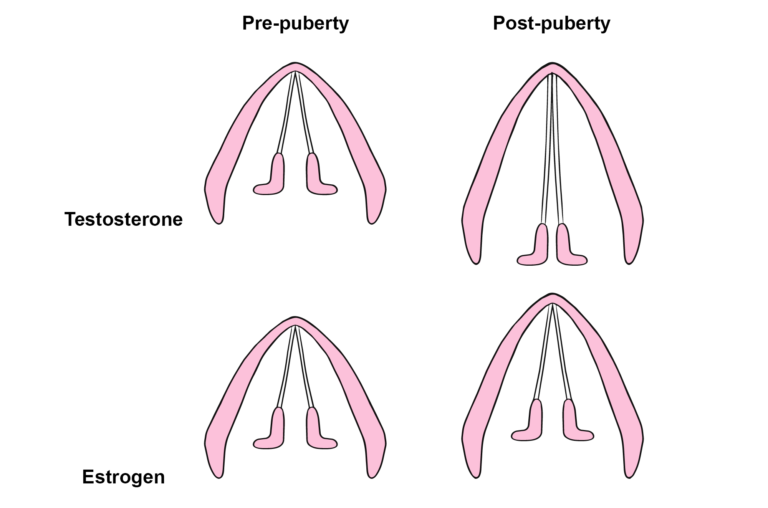
These changes occur due to a phenomenon similar to testosterone-dominant puberty. During testosterone hormone replacement therapy, the vocal folds lengthen and thicken.
The thyroarytenoid muscles bulk up as testosterone levels increase in the body. This structural change causes the vocal cords to vibrate more slowly during voicing, producing a permanently lower f0. It is important to note that these effects are considered irreversible.
Hormone treatment does not, however, result in changes to other aspects of voice that may influence how gender is perceived by others, such as intonation, volume and nonverbal communication. Hence, there is a large subgroup of transmasculine men who desire voice therapy alongside hormone replacement therapy to address other aspects of voice and communication associated with their gender expression.
This voice therapy can address the voice impairments as a result of testosterone use, such as vocal instability, fatigue or projection issues and/or voice goals to masculinise other aspects of voice beyond pitch, such as the voice sounding younger than the person’s chronological age. For the latter aspect, emerging rhetoric and speculation in the speech pathology community suggests this misalignment to expected voicing for age may be due to a mismatch between the bulked up vocal folds and a larynx that has not changed much as a result of the testosterone.
Voice therapy can and should be sought if the above secondary problems associated with the introduced testosterone arise.
Effects of Exogenous Oestrogen on Voice
If a person begins pubertal suppression (also known as puberty blockers) prior to testosterone-driven changes during puberty, and later starts oestrogen, emerging evidence suggests that voice deepening can be prevented. This results in a higher f0 than that of transgender women who underwent testosterone-dominant puberty but is attributed to the prevention of testosterone-induced vocal changes rather than to oestrogen actively raising f0.[6]
For more information on pubertal suppression including recent studies, risks and benefits, please see this Murdoch Children’s Research Institute article: What are Puberty Blockers?
Given that information on the effects of pubertal suppression coupled with GAHT on the voices of transfeminine people is still emerging, most of the gender-affirming voice care provided thus far has been phonosurgery and behavioural voice training.
Footnotes
[1] Unger, C. A. (2016). Hormone therapy for transgender patients. Translational Andrology and Urology, 5(6), 877–884. https://doi.org/10.21037/tau.2016.09.04
[2] Coleman, E., Radix, A. E., Bouman, W. P., Brown, G. R., Vries, A. L. C. de, Deutsch, M. B., Ettner, R., Fraser, L., Goodman, M., Green, J., Hancock, A. B., Johnson, T. W., Karasic, D. H., Knudson, G. A., Leibowitz, S. F., Meyer-Bahlburg, H. F. L., Monstrey, S. J., Motmans, J., Nahata, L., … Arcelus, J. (2022). Standards of Care for the Health of Transgender and Gender Diverse People, Version 8.
[3] Irwig, M. S., Childs, K., & Hancock, A. B. (2017). Effects of testosterone on the transgender male voice. Andrology, 5(1), 107–112. https://doi.org/10.1111/andr.12278
[4] Azul, D., Nygren, U., Södersten, M., & Neuschaefer-Rube, C. (2020). Longitudinal case study of transgender voice changes under testosterone hormone therapy. Journal of Voice, 34(5), 748–759. https://doi.org/10.1016/j.jvoice.2018.10.009
[5] Nygren, U., Nordenskjöld, A., Arver, S., & Södersten, M. (2016). Effects on voice fundamental frequency and satisfaction with voice in trans men during testosterone treatment: A longitudinal study. Journal of Voice, 30(6), 766.e23–766.e34. https://doi.org/10.1016/j.jvoice.2015.10.016
[6] Ciancia, S., Leyns, C., Klink, D., Vervalcke, J., T’Sjoen, G., Cools, M., & D’haeseleer, E. (2026). Long-term effects of gender-affirming hormone therapy from adolescence to adulthood on voice. Journal of Voice. Advance online publication. https://doi.org/10.1016/j.jvoice.2026.01.048
We acknowledge the Wurundjeri Woi-wurrung people as the Traditional Owners of the unceded lands on which these resources were developed.
This resource hub was funded by a 2026 University of Melbourne Student Services and Amenities Fee grant.